Work waits in the gaps
A file is “in progress” while it sits between two roles. Cycle time grows, yet nobody is idle. The delay lives in the handoff, not in the task.


Bălți · Process redesign
Business process redesign
GALINA MANOLII helps leadership teams see how work really moves — across desks, tools, approvals, and silence — then redesign that path so customers, staff, and controls can keep up with the business that already exists.
When the work no longer fits
Most organizations do not fail because people refuse to work. They stall because the path between a request and a result has grown extra loops that nobody designed on purpose.
A file is “in progress” while it sits between two roles. Cycle time grows, yet nobody is idle. The delay lives in the handoff, not in the task.
Controls that once made sense now sit on every ticket. Exceptions become the real process. The official path is theatre.
A new system was bought to fix flow. The old sequence was copied into the new screens. The software is current; the operating logic is not.
The organization works because two experienced staff remember what the chart forgets. That knowledge is not a process. It is a single point of failure.
Promises are made at the front, then quietly renegotiated at the back. Service quality becomes a function of who happens to chase the item.
Redesign asks a harder question than “how do we do this faster?”
It asks whether this piece of work should travel this way at all, who should own the outcome, and what must be true before the next person is allowed to receive it.
GALINA MANOLII treats a process as an operating path: a sequence of decisions, evidence, and handoffs that produces a result a customer or colleague can use. Mapping the current path is only the beginning. The work is to reconstruct a path that the organization can actually run on an ordinary Tuesday.
That is different from painting a target operating model and leaving the team to translate it. It is also different from local efficiency projects that shave minutes off a step while the overall journey stays broken.
Typical outcomes include clearer ownership, fewer loops, controls that sit at the right moment, and a written rhythm so the new path does not dissolve after the workshop energy fades. Explore the services or the practice method.
How the practice is used
See the path that is actually in use.
A structured reading of one or two critical journeys: where work enters, where it stalls, where unofficial routes have replaced the documented ones, and what that costs in time, rework, and customer trust. Full service description
Rebuild the journey from the outcome backward.
A redesigned operating path with named owners, entry conditions, decision rights, and a future-state map the team can rehearse before it becomes policy. Full service description
Fix the joints, not only the tasks.
Redesign of the moments where work changes hands: what must be complete, who may accept it, which checks belong there, and which checks should disappear. Full service description
Keep the new path alive after the map is agreed.
A short operating rhythm, rehearsal sessions, and adjustment loops so the redesigned process survives contact with peak load, absence, and exception. Full service description
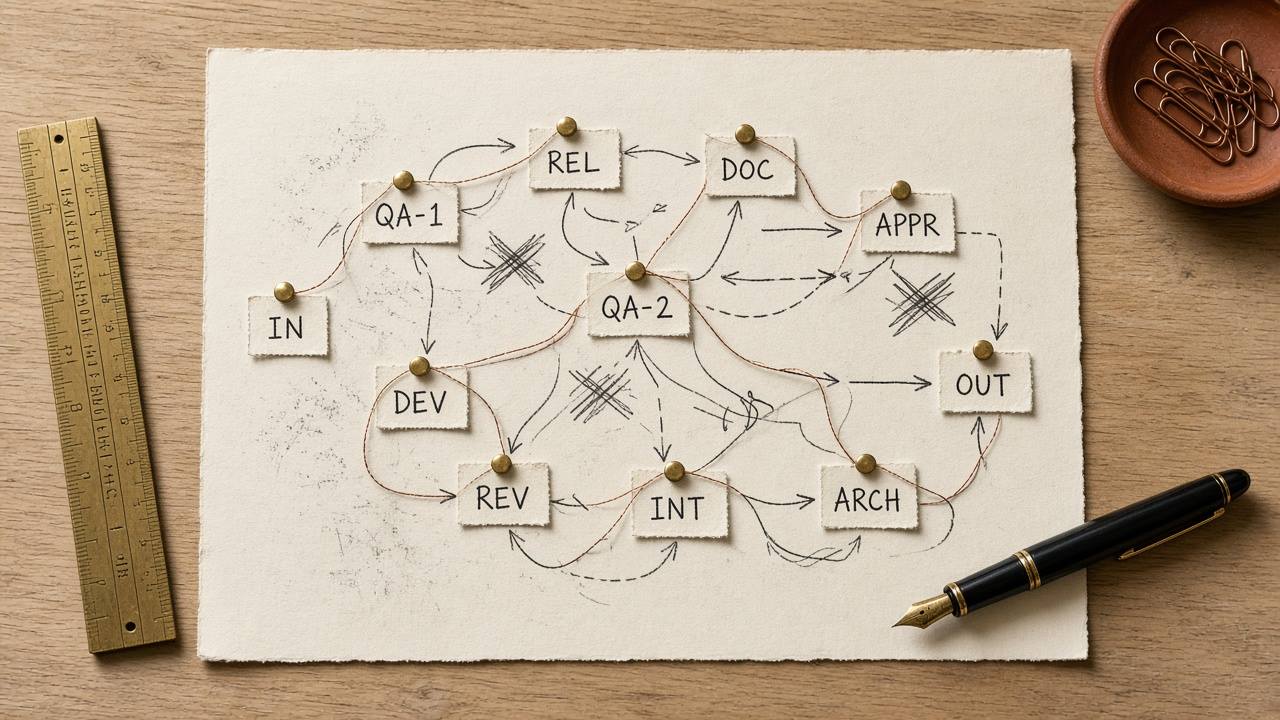
Working method
The practice does not begin with software selection or a generic maturity model. It begins with evidence of how a live process behaves: tickets, folders, inboxes, shop-floor cards, and the conversations people have when the official route fails.
Redesign is then drawn as a path the current team can walk, not a poster for a future headcount the company does not have. Implementation is treated as part of the design, not a later phase owned by nobody.
A core journey is slow, opaque, or dependent on a few individuals. Leadership wants a redesigned operating path, not another workshop that produces a list of local fixes. Someone inside the organization can convene the people who actually do the work.
Software implementation as the main product, ISO certification paperwork, or large-scale organizational restructuring. Those may follow a clearer process. They are not the service advertised here.
Questions visitors usually ask first
No. Tools are examined as part of the path, and requirements can be written for a later systems project. The service is the operating design: sequence, ownership, evidence, and cadence.
No freeze is required. Diagnosis uses live work. Redesign is rehearsed beside the current path until a cutover moment is safe enough to name.
Yes, when the process evidence can be shared and the right people can join working sessions. On-site days in Bălți or elsewhere in Moldova are used when the work is physical or the room needs to be in one place. Details are agreed before work starts.
Write from the contact page or email info@digitalmadobs.my. The practice is GALINA MANOLII, Stradela Muncii 15, MD-3501, Bălți, Republica Moldova.